
Here are some resources, news, and tips from EDI Partners that might help.

Welcome to the EDI Partners blog, where you’ll find a wealth of knowledge and insights on Electronic Data Interchange (EDI). Our experts are dedicated to providing you with industry-specific content to empower your business. In our articles, we aim to share our deep expertise, answer your questions about electronic data interchange, and help you grasp the full potential of what we can do for your organization.

15 Must-Ask E-Invoicing RFP Questions
July 14, 2026 / by EDI Partners
With the changing global tax regulations and rapid digital transformation, e-invoicing is becoming a vital component of financial operations. Due to real-time reporting mandates and varying compliance requirements across countries, businesses can no longer rely on outdated invoicing systems. Even choosing an e-invoicing partner requires careful decision-making, and this starts with asking the right questions in your Request for Proposal

Omnichannel Retail and EDI: Real-Time Inventory & AI Forecasting
July 9, 2026 / by EDI Partners
Assume that a customer orders a product online for same-day pickup, and upon arriving at the store, he finds that the store’s inventory is wrong. Meanwhile, another customer abandons their cart because an item listed as “in stock” is actually backordered. These situations are common, and they highlight a growing operational problem of disconnected systems. That is exactly why EDI
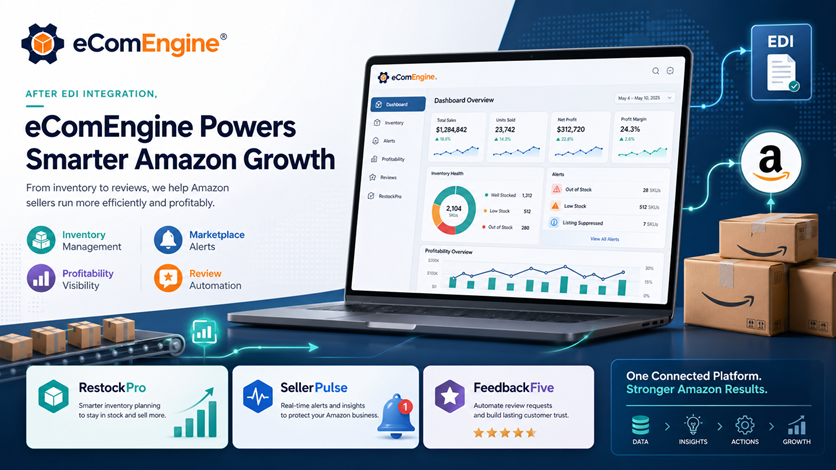
Make Your Amazon Operations Work Smarter After EDI Integration
May 9, 2026 / by EDI Partners
For ecommerce businesses, few things are more frustrating than operational friction. Orders need to move. Inventory needs to be accurate. Shipping information needs to be exchanged correctly. Retail partners need clean, reliable data. Internal teams need fewer manual tasks, fewer preventable mistakes, and fewer “why is this broken again?” moments before the second cup of coffee. That is exactly why

Manufacturing 4.0: Predictive EDI Analytics & Real-Time Integrations
April 15, 2026 / by EDI Partners
Over the past few years, the manufacturing industry has undergone a huge transformation. This is due to the development of tools and technology. Electronic Data Interchange (EDI) is one such technology driving change. It simplifies document exchange and enables predictive analytics and real-time integrations. Businesses in the manufacturing sector are adopting EDI solutions to predict outcomes, optimize operations, and build
EDI vs Peppol: What’s the Difference?
April 9, 2026 / by EDI Partners
A major challenge for organizations today is how to send and receive documents smoothly between different business systems. While a seller might use one ERP platform, a buyer may use another one, making it difficult for systems to understand information without manual intervention. Technologies like EDI and Peppol help in such situations by facilitating structured electronic document exchange. Let’s understand
Experience Simplified Data Exchange with EDI Partners
EDI Partners isn't just another EDI service; we're your long-term partner in data exchange. Say goodbye to data management headaches and step into the future with simplified, efficient, and personalized EDI solutions.
Talk with a senior EDI expert about your requirements, trading partners, systems, and path to a cleaner operating model.